34. Pressure¶
34.1 Force over area¶
Pressure is a force pressing perpendicularly on a surface, divided by the area it acts on:
where
| \(p\) | pressure | Pa (1 Pa = 1 N m\(^{-2}\) = 1 kg m\(^{-1}\) s\(^{-2}\)) |
| \(F\) | force | N |
| \(A\) | area | m\(^2\) |
The same force on a smaller area gives a larger pressure: a sharp knife cuts where a blunt one squashes. Pressure itself has no direction; but when it differs from one side of an object to the other, the object feels a net force from high towards low pressure. That is why air moves from high to low pressure, and how a straw works.
At sea level the atmosphere presses with about \(10^5\) Pa (1 atm = 101 325 Pa = 1013.25 hPa). We are not crushed because the same pressure acts inside our bodies, so there is no net force. Our senses notice changes in pressure, in the air-filled cavities of the ears and sinuses, when we fly or dive.
34.2 Hydrostatic pressure¶
In a fluid at rest, the pressure at any level is the weight of the fluid above it, per unit area. For a layer of uniform density,
where
| \(\rho\) | density of the fluid | kg m\(^{-3}\) |
| \(g\) | gravitational acceleration | 9.81 m s\(^{-2}\) |
| \(z\) | height of the column above | m |
Ten metres of sea water
\(p = 1025 \times 9.81 \times 10 = 1.01\times10^{5}\) Pa: one extra atmosphere for every 10 m of depth. A diver at 30 m feels 4 atm: one from the air, three from the water.
In the air, density itself falls with height (air is compressible), so pressure does not fall in a straight line but exponentially: each step up of the same size removes the same fraction of the pressure,
The height at which pressure halves
With a mean temperature of 250 to 288 K, \(H = 287 \times T / 9.81\) is 7.3 to 8.4 km, so pressure halves every \(0.693\,H\) = 5.1 to 5.8 km. The handbook’s “about 5.6 km” is in this range; Part I used the same rule (Chapter 7).
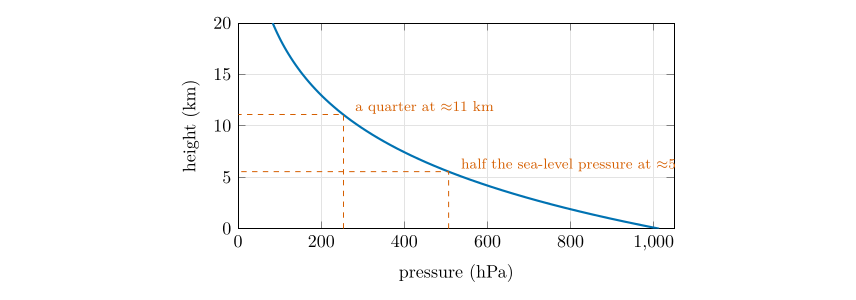
Figure 34.1. Pressure falls exponentially with height (34.3), drawn with \(H = 8\) km: every 5.5 km or so it halves.
34.3 Pressure, density and wind¶
The hydrostatic equation explains why temperature differences make wind. Cold air is dense, so a column of cold air is shorter than a column of warm air holding the same mass. At a given height aloft, the pressure is therefore higher over the warm column than over the cold one: a horizontal pressure gradient that pushes air from the warm side towards the cold side aloft, and so sets up a circulation. Because the Earth rotates, the Coriolis effect turns the moving air to the right in the Northern Hemisphere (left in the Southern) until it flows nearly along the isobars rather than straight across them; near the equator, where the Coriolis effect is weak, winds blow more directly down the pressure gradient (Part III, Chapter 23).
Pressure patterns can shift on large scales: every three to eight years the usual high pressure over the eastern tropical Pacific and low over the western Pacific weaken or reverse (the Southern Oscillation). The trade winds slacken, warm water spreads east, and El Niño affects weather around the world.
34.4 Gases squeeze, water does not¶
Water is almost incompressible: at 4 km depth, under 400 atm, its volume shrinks by less than 2 %. A gas is very compressible. At constant temperature, the volume of a fixed amount of gas is inversely proportional to its pressure (Boyle’s law):
Halve the pressure and the volume doubles; double it and the volume halves. This is why your ears hurt only a few metres down in a pool (the air in them is squeezed) while the rest of your body, mostly water, hardly notices.
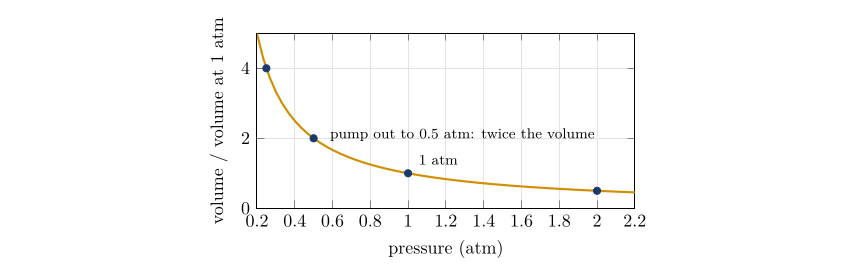
Figure 34.2. Boyle’s law (34.4) for air at constant temperature. The balloon under vacuum (§ 37.1) and the Cartesian diver (§ 37.3) both follow this curve.
34.5 Expansion cools: the key to clouds¶
When a gas expands quickly, without time to exchange heat with its surroundings (adiabatically), it does work pushing outwards and so cools; compressed, it warms (a bicycle pump gets hot). For dry air,
Pumping a flask down to half pressure
\(T_2 = 293 \times 0.5^{0.286} = 293 \times 0.820 = 240\) K: a fall of more than 50\(^{\circ}\mathrm{C}\)if no heat flowed in. In the flask the walls warm the air back within seconds, but the brief chill is enough to make a cloud if the air is moist and has particles to condense on (§ 37.1).
A rising air parcel meets lower pressure, expands and cools the same way, about 10\(^{\circ}\mathrm{C}\)per kilometre while it is dry (Part I, Chapter 8). When it cools to its dew point, cloud forms. Almost every cloud in the sky is made this way.