32. Density¶
32.1 What density is¶
Density measures how compactly matter is packed: the mass in a given volume,
where
| \(\rho\) | density | kg m\(^{-3}\) (or g cm\(^{-3}\); 1 g cm\(^{-3}\) = 1000 kg m\(^{-3}\)) |
| \(m\) | mass | kg or g |
| \(V\) | volume | m\(^3\) or cm\(^3\) (1 mL = 1 cm\(^3\)) |
Density does not depend on how much material you have: a cup and a bath of the same water have the same density. That is what makes it useful for following air masses and water masses around the globe.
Measuring a density in the lab
Weigh an empty beaker: 52.0 g. Pour in exactly 100 mL of the salt solution and weigh again: 154.5 g. The liquid’s mass is \(154.5 - 52.0 = 102.5\) g, so
Check: sea water is 1020 to 1030 kg m\(^{-3}\), so a solution of about 35 g of salt per litre is sea-like.
32.2 Air and water compared¶
Water is about a thousand times denser than air (Table 32.1). Air at sea level and 15\(^{\circ}\mathrm{C}\)has a density of about 1.225 kg m\(^{-3}\); fresh water at room temperature 998 kg m\(^{-3}\); most ocean water 1020 to 1030 kg m\(^{-3}\); salt lakes up to about 1250 kg m\(^{-3}\).
| Substance | Density (kg m\(^{-3}\)) |
|---|---|
| Air, sea level, 15\(^{\circ}\mathrm{C}\) | 1.225 |
| Air, sea level, 30\(^{\circ}\mathrm{C}\) | 1.164 |
| Air at 300\(^{\circ}\mathrm{C}\)(in a flame plume) | 0.62 |
| Fresh water, 50\(^{\circ}\mathrm{C}\)/ 20\(^{\circ}\mathrm{C}\)/ 4\(^{\circ}\mathrm{C}\)/ 0\(^{\circ}\mathrm{C}\) | 988.0 / 998.2 / 1000.0 / 999.8 |
| Sea water | 1020–1030 |
| Ice | 917 |
Table 32.1. Densities met in this practical.
32.3 Why warming makes a fluid lighter¶
Heating makes molecules move faster and push further apart, so a parcel’s volume grows while its mass stays the same: by (32.1) its density falls. Cooling does the opposite. For a gas this is the ideal gas law, which links pressure, density and temperature:
where
| \(p\) | pressure | Pa |
| \(R_d\) | gas constant for dry air | 287 J kg\(^{-1}\) K\(^{-1}\) |
| \(T\) | temperature | K |
It contains three rules worth knowing by heart:
-
at constant volume, pressure rises with temperature;
-
at constant temperature, pressure rises with density (squeeze a gas and it pushes back harder);
-
at constant pressure, density falls as temperature rises: warm air is light air.
Air density at two temperatures
At sea level, \(p = 101\,325\) Pa. At 15\(^{\circ}\mathrm{C}\)(\(T = 288.15\) K): \(\rho = 101\,325/(287 \times 288.15) = 1.225\) kg m\(^{-3}\). At 30\(^{\circ}\mathrm{C}\)(\(T = 303.15\) K): \(\rho = 101\,325/(287 \times 303.15) = 1.165\) kg m\(^{-3}\), about 5 % lighter. At 300\(^{\circ}\mathrm{C}\), inside a flame’s plume: \(\rho = 101\,325/(287 \times 573.15) = 0.616\) kg m\(^{-3}\), half the density of the room air: this is why the teabag rocket flies (§ 36.6).
Water behaves the same way above 4\(^{\circ}\mathrm{C}\), but has a famous quirk: it is densest at about 4\(^{\circ}\mathrm{C}\), and ice (917 kg m\(^{-3}\)) floats. Figure 32.1 shows both fluids.
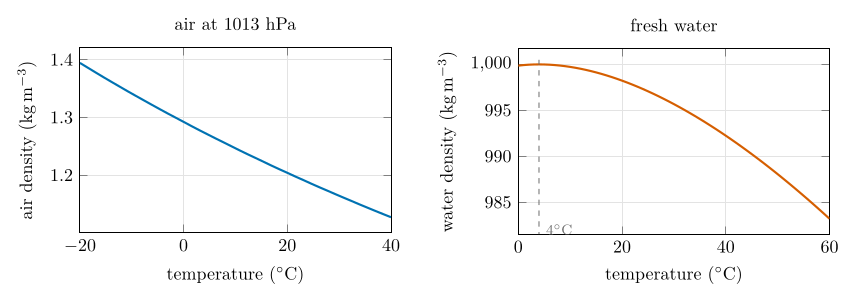
Figure 32.1. Density falls as temperature rises. Left: dry air at sea-level pressure, from the ideal gas law (32.2). Right: fresh water, from a standard empirical fit to measured densities (accurate to about 0.1 kg m\(^{-3}\) here); note the maximum near 4\(^{\circ}\mathrm{C}\).
32.4 Stratification, mixing and fronts¶
When fluids of different density meet, the denser one slides underneath and the lighter one spreads over the top, until they lie in layers ordered by density: stratification. A stratified fluid resists vertical mixing, because lifting dense fluid or pushing light fluid down takes work.
In the atmosphere, density falls with height together with pressure, but temperature differences set up horizontal density differences too: warm and cold air masses. Where they meet, the colder, denser air wedges underneath and lifts the warmer air (frontal wedging). The lifted air expands and cools, and its moisture condenses into cloud and rain (Part III, Chapter 29). In an occlusion, a cold front catches up with a warm front and the warm air is lifted entirely off the ground. In the ocean the same physics, driven by temperature and salinity, sets the layering of the water column and the deep overturning circulation.
Does salt matter in the air?
No: salinity sets the density of sea water, but air has no salt in that sense. In air, density differences come from temperature and, to a smaller extent, humidity (moist air is slightly lighter than dry air at the same temperature and pressure, because water vapour molecules are lighter than nitrogen and oxygen). The divided-tank experiment uses salt because it gives a large, steady density difference that is easy to see; the principle carries over.